Think about how you looked for a supplier five years ago. You typed a few words into Google, opened half a dozen tabs, and compared websites.
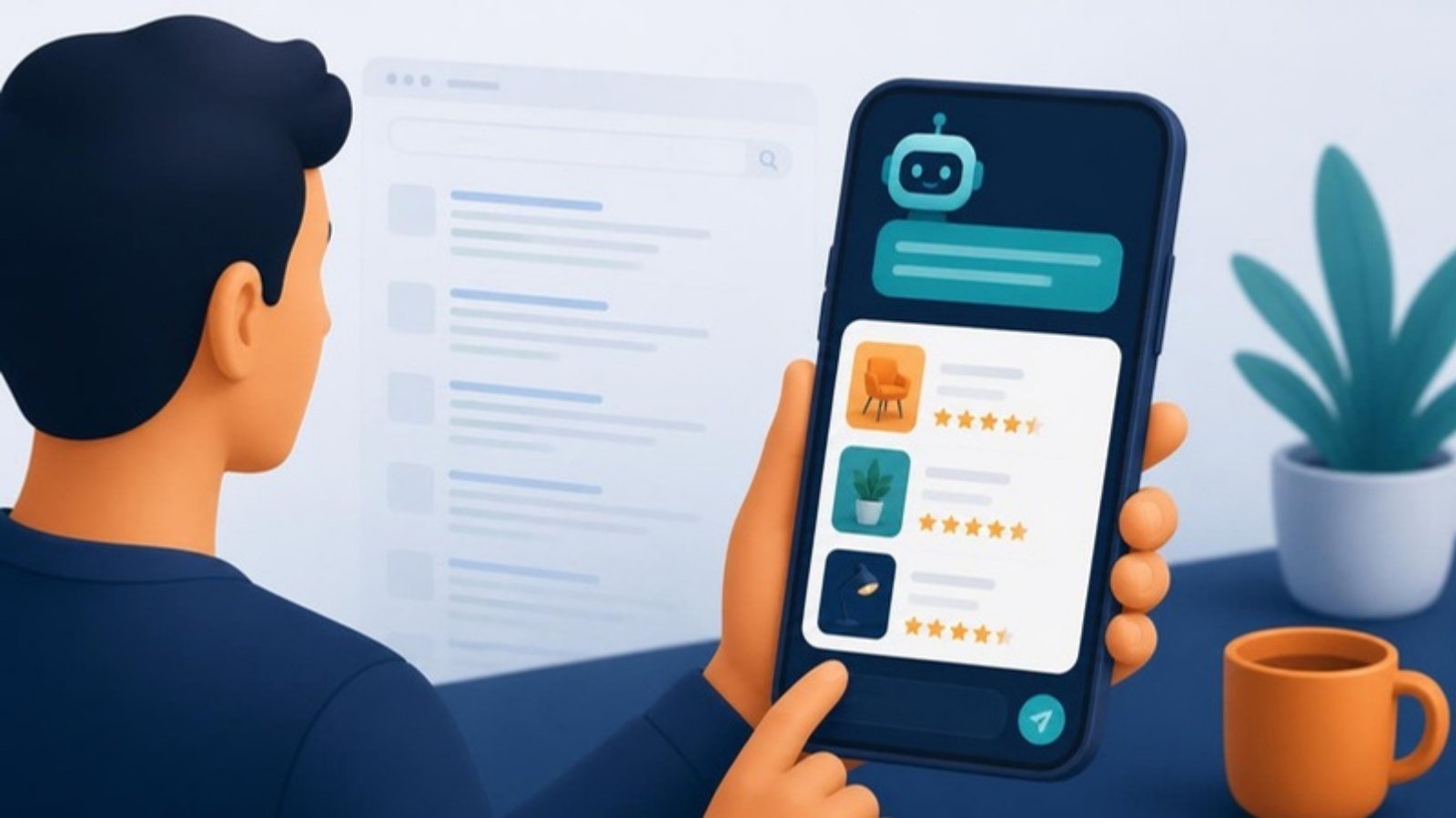
Now picture how a lot of people do it today. They type a long, rambling question into ChatGPT, something like “I run a small dental clinic and my website gets traffic but no bookings, who can help with that?”, and get back a short list of three or four names with a reason next to each one. No ten blue links, no comparing five websites. They ask a question, get a shortlist, and pick from it.
That’s the shift every business owner needs to understand right now. If your business isn’t in that answer, you aren’t on the shortlist, however good your Google rankings look.
Key takeaways
- AI assistants like ChatGPT, Gemini, Perplexity and Google AI Overviews now shortlist businesses for customers before they ever visit a website.
- They recommend businesses they can find, understand and trust: clear websites, consistent details, reviews and mentions on other sites.
- Strong SEO is still the foundation, but ranking on page one is no longer enough on its own.
- You can check where you stand in 10 minutes, and most fixes are practical marketing basics done thoroughly.
The big shiftWhy this matters more than you might think
A few numbers put the change in perspective:
The takeaway isn’t that SEO is dead. It isn’t. But ranking on page one is no longer the finish line. The real question is whether AI tools mention you when someone asks for a recommendation in your field.
Generative Engine Optimisation (GEO), also called AI SEO or Answer Engine Optimisation, is the work of making your business easy for AI assistants to find, understand and trust, so they cite and recommend you in their answers.
Behind the answerHow AI assistants decide who to recommend
None of the AI companies publish their exact formula. But from testing prompts across different industries and watching which businesses show up and which don’t, the pattern is fairly consistent. When someone asks “who’s the best X for Y?”, the assistant roughly does four things:
- Understands the requestThe service, the location, and details like budget, urgency or industry.
- Finds candidatesFrom training data and live web search. ChatGPT leans heavily on Bing; Gemini and AI Overviews use Google.
- Checks trustDo several independent sources agree about this business? Are there reviews?
- Recommends a fewUsually three to five names, each with a one-line reason.
Step three is where most businesses lose out. AI models are built to avoid confidently recommending something they can’t back up. If the only place your business is described is your own homepage, and even that is vague, the model has very little to go on.
If one friend recommends a plumber, that’s useful. If your neighbour, a local Facebook group and a review site all name the same plumber, you call them. AI works the same way, just at scale.
The playbook8 steps to get your business recommended by AI
Here’s what we focus on when we’re trying to get a business mentioned in AI answers. None of it is a trick. It’s mostly good marketing, done thoroughly.
Say exactly what you do, for whom, and where
This sounds obvious, but it’s the most common problem we see. Vague copy gives an AI model nothing to match against a customer’s question.
Give each service its own page
One “Services” page listing ten things in bullet points is hard for AI to quote. A dedicated page for each core service, explaining what it includes, who it’s for, how it works and roughly what it costs, gives the model a clear source to cite. Pages focused on one topic get cited far more often than pages that try to cover everything.
Answer the questions people actually ask
People talk to AI assistants in full sentences: “How much does a small business website cost?” “Do I need a new website or just better SEO?” If your site answers those questions directly, in plain language, you become a natural source.
Back up your claims with specifics
Research on generative engines (the original GEO study from Princeton and partners) found that adding statistics, citations and quotations noticeably increased how often content appeared in AI-generated answers. That matches what we see.
“We help businesses grow” is forgettable. A specific, verifiable result, like “we rebuilt a clinic’s booking page and online bookings rose 40% in three months”, is something a model can repeat. Use real numbers, name your methods and link to credible sources.
Get reviewed in more than one place
Reviews are one of the strongest trust signals for AI recommendations, especially for local and service businesses, and it isn’t only Google. Depending on your industry, that could mean Google Business Profile, Yelp, Trustpilot, Clutch, the Better Business Bureau, Facebook, or niche platforms like Healthgrades or Houzz.
Keep your business details identical everywhere
Your business name, address, phone number, website and description should match across your website, Google Business Profile, Bing Places, Apple Business Connect, social profiles and directories.
Bing Places is the one most businesses forget, and it matters because of ChatGPT’s reliance on Bing. If one directory calls you a “marketing consultancy” and another says “IT services”, you’re making the model’s job harder.
Get mentioned on sites that aren’t yours
This is the modern version of link building, except the mention itself matters even without a link. Guest articles, podcast appearances, local news features, industry roundups, partner pages and genuine answers on Reddit or Quora all create independent sources that describe what you do.
When we look at the businesses AI tools recommend most often in a niche, they nearly always show up across a wide spread of third-party sites, not just their own.
Make your site easy for machines to read
A few technical basics make a real difference:
- Don’t block AI crawlers by accident. Check robots.txt and your security or CDN settings. Some block OAI-SearchBot, GPTBot, PerplexityBot or Google-Extended by default. If they can’t read your site, they can’t cite it.
- Add structured data (schema). Organization or LocalBusiness, Service, FAQ and Review schema tell machines exactly what your pages are about.
- Use a named author. Content with a real person or clear organisation behind it, with a short bio, is treated as more trustworthy.
- Keep it fast and clean. Plain text that loads quickly is easier to parse than content hidden in sliders, tabs or images.

Check where you standThe 10-minute AI visibility test
Before you change anything, find out where you stand. Open ChatGPT, Gemini and Perplexity (in a private or logged-out window if you can) and ask each one:
Note whether you appear, what’s said about you, whether it’s accurate, and which competitors show up instead. Then look at the sources the AI cites. Those are the websites you want to be on.
The third question is often the most revealing. We’ve seen AI tools describe businesses with out-of-date services, wrong locations and occasionally a mix-up with a similarly named company. You can’t fix what you haven’t seen.
Avoid theseCommon mistakes we see
Treating AI visibility as separate from SEO
It builds on SEO, it doesn’t replace it. A slow, thin, poorly structured website struggles in both.
Publishing lots of generic AI-written content
Pages that read like everyone else’s give AI nothing new to cite. Original opinions, real examples and first-hand experience stand out.
Ignoring the off-site picture
You can perfect your website and still be invisible if no one else on the web mentions you.
Expecting overnight results
Some changes show up within weeks in tools that search live. Others take months as models are retrained.
Trying to game it
Fake reviews, keyword stuffing and hidden text are as risky here as they are with Google, and AI systems are getting better at spotting them.
Start todayYour action plan for this week
If all of this feels like a lot, start small. Work through these in order:
- Run the 10-minute testSave the answers from each AI tool as your baseline.
- Rewrite your homepage’s opening lineState clearly what you do, who for, and where.
- Check robots.txtMake sure you aren’t blocking AI crawlers.
- Complete Google Business Profile and Bing PlacesMake sure your details match everywhere else.
- Ask five happy customers for a reviewIdeally on a platform other than Google.
- Build one detailed service pagePick your most important service and add an FAQ answering real customer questions.
Then run the same test again in 60 days and compare the results.
FAQFrequently asked questions
Can I pay to be recommended by ChatGPT?
No. You can’t currently buy a place in ChatGPT’s or Gemini’s organic recommendations. Some AI platforms are experimenting with ads, but those are labelled separately. Organic AI recommendations are earned through the signals described in this guide.
Is GEO different from SEO?
They overlap a lot. Good SEO (a fast site, helpful content, a strong reputation) is the foundation. GEO puts extra weight on clear, quotable answers, consistent information across the web, third-party mentions and reviews, and making sure AI crawlers can access your site.
How long does it take to show up in AI answers?
For tools that search the web in real time, like ChatGPT search and Perplexity, improvements can appear within a few weeks of your pages being indexed. Changes to what a model “knows” without searching take longer, because they depend on retraining. Most businesses should expect a few months of steady work.
Do I need an llms.txt file?
It’s a proposed standard for giving AI tools a summary of your site. It’s cheap to add and doesn’t hurt, but there’s little evidence so far that the major assistants rely on it. Prioritise the basics in this guide first.
Does this work for small businesses, or only big brands?
It works well for small businesses, often better. AI tools are good at matching specific needs (“a web designer who works with dental clinics”) to specific businesses. A small business that clearly owns a niche can beat a big generalist in AI answers.
Want to know what AI is saying about your business?
At Orient Digital Solutions we work on web development, SEO and AI-driven marketing every day, and AI visibility is now part of every project we take on. Our free AI visibility audit shows you exactly where you stand:
- How ChatGPT, Gemini, Perplexity and Google AI describe your business
- Which competitors get recommended instead of you, and why
- A short, prioritised list of fixes that will make the biggest difference
Sources: SparkToro zero-click study via Search Engine Land (June 2026); Ahrefs, “AI Overviews Reduce Clicks” (February 2026); OpenAI DevDay 2026; Google I/O 2026; Aggarwal et al., “GEO: Generative Engine Optimization” (Princeton University et al.).